


June 25, 2025
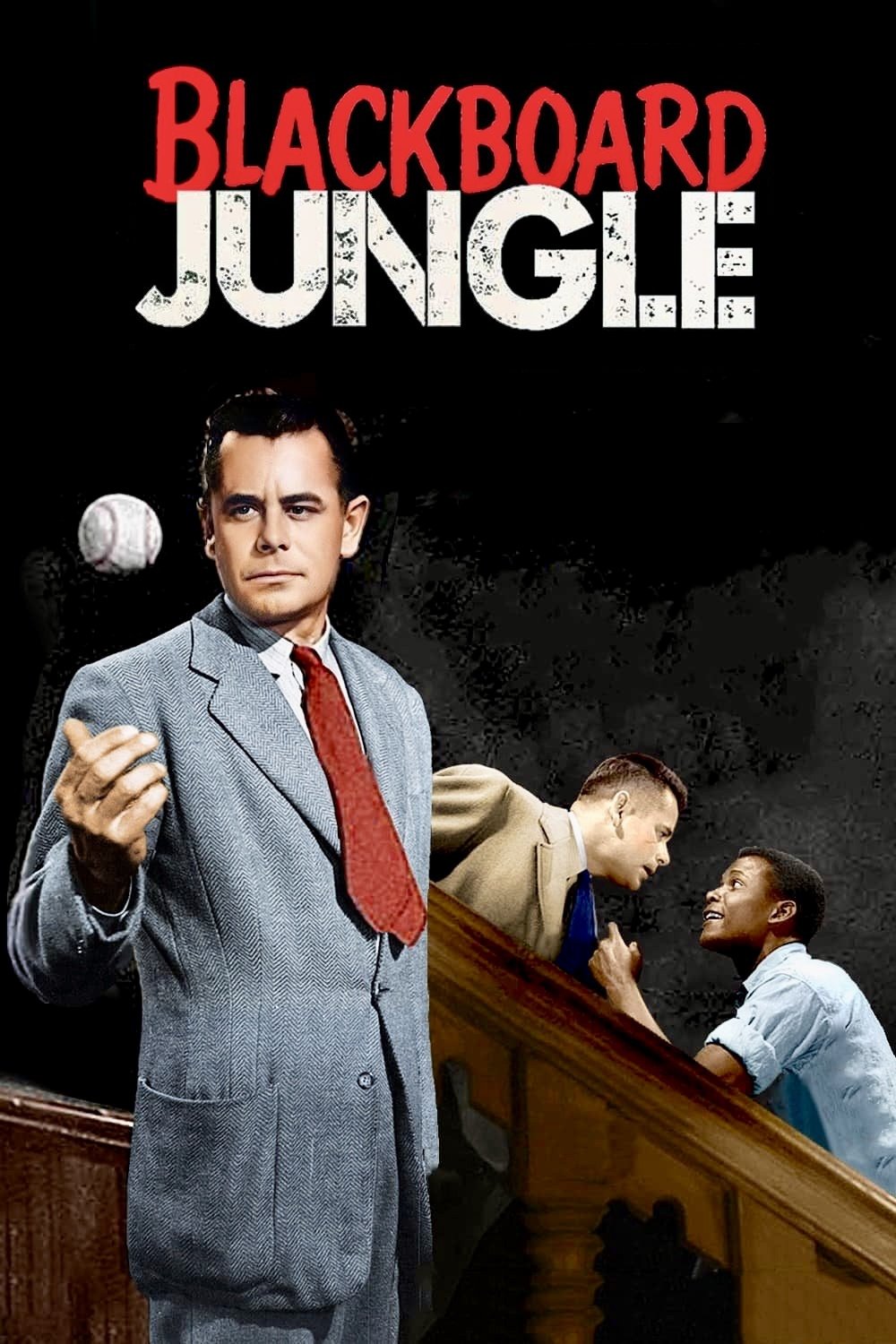
Spiritually Speaking at The Movies. The BlackBoard Jungle, 1955 B&W. 1hr41m. Glen Ford (Richard Dadier) Vic Morrow (Artie West) Sidney Poitier, Anne Francis; violence, crime, drinking, smoking, “replacement swearing”, suggestive sex, attempted rape. Not rated. B&W. Should you see it? Yes, see it, for the sake of understanding who we are as America now, where we came from and where we are going … or could be.
The Blackboard Jungle (BBJ) is a movie with a problem. “It’s those crazy kids,” it tells us early on. Those crazy high school kids are recalcitrant, intransigent, snide, sneaky and sassy. They also can be dangerous. But crazy kids, born during WWII, are just the surface problem. The roots of those problems, and how to overcome them, is what the story is about.
Released in 1955, the film is set in post World War II America where —a kindly but serious police detective tells us — “The father was in the army and mom was in a defense plant. The kids had no place to go. They form street gangs. Gang leaders have taken over the place of parents, and if you don’t stop them…well.”
Who knew that defending the country from Nazi’s and the Japanese military machine, could hurt years later in this way? War widows we can understand, but the children born in the war is a more hidden, underwater reef.
The detective is saying his piece to a new teacher — already a victim of teen violence from his own students. The cop wants the “Teach” to finger the culprits. The teacher declines to help the detective. He’s going to go it alone. But does that really work?
The Black Board Jungle for us today is a time machine to an era long forgotten, with a philosophy that has come under some heavy criticism today, which is: a type of accommodation. The story is set in a major metropolitan East coast city, a thinly veiled New York City. In an all-boys high school, a rookie teacher, Richard Dadier, with wide eyes and aspirations, is grateful just to get a job.
Soon, though, the job literally beats him up and the new question becomes, how will he handle it? Anger? Violence? Apathy? Vengeance? Quitting? Or something else? The film’s challenge puts us in the driver’s seat, asking, “which way would you turn?”
Here-in lies the necessary violent teen scenes to illustrate the available character responses, including ours. This film was denied entry into an international film festival for such portrayals. In the light of 21st century John Wick movies, it all seems so tame. But 1955 America wanted to look the other way to a large degree. The Black Board Jungle opened up a genre of violent films that exploded in the 1960’s and is still with us today.
As a viewer, you are now at the vivid intersection where faith or failure meet. One wrong turn could mean disaster. And there are shipwrecks along the way in this storm-tossed story for us to consider; the well-meaning, but weak math teacher; the bored female teacher who seeks to “run away” with anyone, away from it all; the apathetic and cynical veteran of teaching who can’t be bothered with the problems of delinquents anymore. We find ourselves at the eye of the hurricane, where Richard Dadier is.
There is a surprise spiritual inclusion in the midst of the story, in the form of students seen singing spirituals during a play rehearsal. I won’t reveal what was said, but the scene is there for a reason; not all kids, even the ones you suspect, are bad.
There is an authenticity to the grit of the rebellious teens of BBJ that almost certainly would be lost on today’s teenage rebels. But the real connection is this; these are some of the grandparents of today’s teen societal problems. What is passed down from such boys-turned-to-men, to their children, and children’s children? It is not hard to believe their damage, so long ago, is still with us. What will truly remedy that?
Black Board Jungle’s approach postulates that, “Love and understanding and patience,” will be the tonic that will deliver. That tactic, however, did not keep a kid with a switchblade intent on killing his teacher, the film’s protagonist, in the classroom in the film’s final dramatic scene.
What then, shall we do? How then should we live?
Spiritually Speaking, a good way to realistically connect to the authentic era of urban 1950's — and its solution — is to read the 1958 story of The Cross and the Switchblade by David Wilkerson, or see the movie by the same name. It is as concurrent to the Black Board Jungle as one can get, and takes place in the real New York City, with real gangs, real switchblades and real, deadly “JD’s,” juvenile delinquents.
Wilkerson was the real-life country minister who went to those gangs — the ones who killed for kicks, featured in genuine, blazing headlines in New York City at the time. He had a real switchblade pulled on him, not a Hollywood prop. It was fearsome and deadly gang warlord Nicky Cruz who threatened to kill him, not Hollywood actor Vic Morrow.
The difference between the entirely humanistic approach of Black Board Jungle — which became societies’s remedy sans God - and Wilkerson’s real-life strategy, was the actual introduction of Jesus Christ as Savior to mega-violent Warlord Cruz and his gang, the Mau Mau’s. Who would ever believe that could work? Wilkerson did, and he tried it.
Astonishingly, that encounter did the trick for all of them. The leader of the Mau Mau’s, named Israel, (appropriately enough) led his boys to faith meeting with Wilkerson, and they all “gave their hearts” to Jesus in one night. They were literally transferred from their kingdom of darkness to the kingdom of his Beloved Son. Evidently, all they had to lose were their chains, spiritually and literally.
If that seems like religious hyperbole, read the Cross and the Switchblade in one evening as I did, then try to explain what happened in another way. I’d like to hear it.
As a result, Wilkerson started Teen Challenge, having an international reach, and the organization still exists. To this day, Cruz speaks to troubled youth, even via Facebook.
Black Board Jungle is also fascinating to see the roots of what would become a sort of standard operating procedure in dealing with troubled youth. Racism is addressed. Absentee parents are blamed. Lack of support for teachers is inserted. Authority vs. influence, ie, police or teachers in reaching kids is highlighted in a long scene that is worthy of a panel discussion.
But it is Wilkerson who arrived in NYC just two years after Black Board Jungle was released, who had the longest, most effective, far reaching and transforming solution. A guest of Presidents and politicians at home and abroad, Wilkerson was hailed for his, yes, heroic efforts to reach the lost teenaged souls of the street.
The Blackboard Jungle shows us that every generation has its scarring obstacles and lacerating moments. There is a lack in the human spirit needing filling in a sustainable way. The Cross and the Switchblade tells us there is a solution to that lack, if you care to look at it in unvarnished fashion.
Recommendation: See The Black Board Jungle and read the Cross and the Switchblade or see the movie to see how it all panned out in the end.
Spiritually Speak Addendum 1: For East Texans, note that David Wilkerson came to Smith County to set up a quiet, peaceful place for New York gang members to get out of the city. 500 acres were purchased and its first attendees were Cruz and Israel (who had never seen a cow, said Cruz). That property today is owned by Youth With A Mission, located in Garden Valley, Texas.
Spiritually Speaking Addendum 2 : The film’s musical anthem is Bill Haley’s “Rock Around the Clock,” which made the fading song a forever classic — and always associated with teen age rebellion. So much for “Happy Days.” But there is also a not-so-hidden message here that “jazz is elegant” (says the math teacher). Rock is bad and for rebels. That was much of the musical thinking of the day, as rock dawned in America under heavy resistance. But never mind that early jazz had its roots in speakeasies, gin houses, prohibition drinking and houses of ill repute. There was plenty of law-breaking associated with that music.

.jpg)